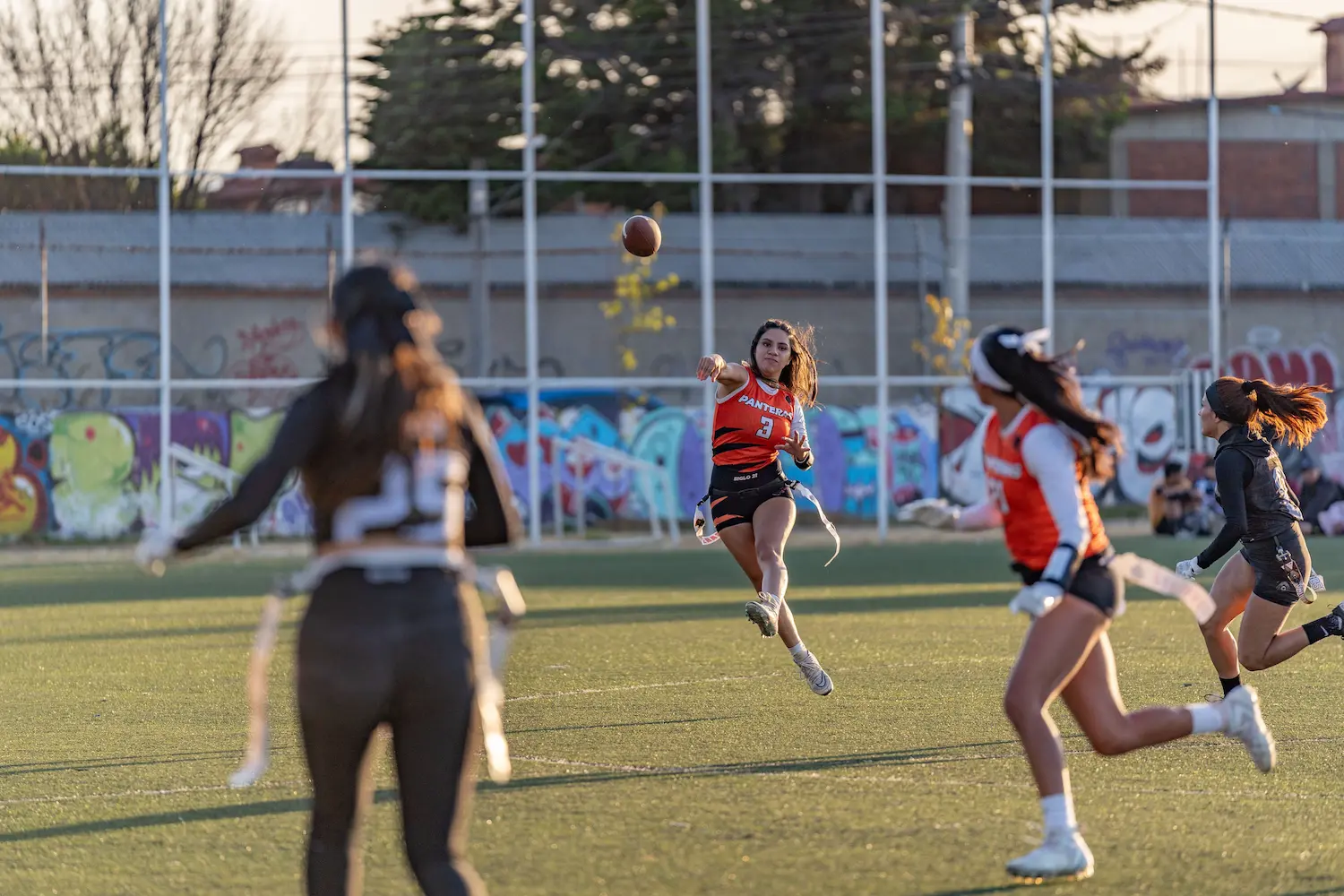
Getting a flag football scholarship in the USA stopped being a distant idea in 2026. The NCAA is on the verge of turning women's flag football into an official championship sport, and in 2028 the sport will make its Olympic debut at the Los Angeles Games. For an international athlete, that translates into something very concrete: schools are opening roster spots right now, and there's still relatively little competition for those spots because the sport is just becoming formalized. This article breaks down exactly what's happening, which schools are already recruiting, what requirements you need to meet, and how to get in before demand spikes — the same way it has for every sport that reaches Olympic status.
Why 2026-2028 is a historic window for women's flag football
The International Olympic Committee approved flag football for the Los Angeles 2028 program back in 2023, alongside cricket, baseball-softball, lacrosse, and squash. That decision set off a chain reaction inside the US college sports system.
In January 2026, at the NCAA Convention, women's flag football was officially added to the Emerging Sports for Women program — the same pathway that has historically turned other sports into full NCAA championships. Then in May 2026, the NCAA's Committee on Access, Opportunity and Impact voted to recommend a national women's flag football championship, with a first edition projected for spring 2028, timed to the sport's Olympic debut.
For that recommendation to move forward, at least 40 schools need to sponsor the sport at the varsity level. That threshold has already been cleared: roughly 60 schools sponsored it at the varsity level in spring 2026, according to NCAA.org.
This pattern isn't new. Here's how other sports moved from "emerging" to full NCAA championship status through the same program:
| Sport | Year it became an NCAA championship |
|---|---|
| Rowing | 1996 |
| Ice hockey | 2000 |
| Water polo | 2000 |
| Bowling | 2003 |
| Beach volleyball | 2015 |
| Women's wrestling | 2025 |
| Acrobatics and tumbling | 2026 |
| Stunt | 2026 |
| Flag football (projected) | 2028 |
Women's flag football participation grew more than 60% year-over-year at the high school level in the US, and participation among girls ages 6 to 12 increased 283% between 2015 and 2024, according to data cited by USA Football.
For a family evaluating this path, the takeaway is simple: when a sport is in this "emerging" stage, programs are still building their roster and competitive identity. That means fewer established players competing for each spot compared to already-saturated sports like soccer or basketball.
Which schools already recruit for flag football scholarships (and which are coming)
Growth here isn't concentrated in a handful of traditional powerhouses, which is exactly what makes this moment interesting. With around 60 active varsity programs in 2026 and the Big 12 conference exploring an official addition — with at least six member schools interested ahead of 2028, according to CBS Sports — there's a wide range of programs building their rosters from the ground up.
That shifts recruiting dynamics in your favor:
- Coaches at new programs need to fill roster spots fast and are more open to evaluating international athletes.
- There are fewer established "names" competing for media attention, so your video and direct outreach carry more weight.
- Entire conferences, not just individual schools, are choosing to invest — which gives mid-term stability to athletes who get in now.
These are confirmed programs with real names attached, not abstract promises:
- NCAA Division I: Alabama State, Long Island University, Mercyhurst, and Mount St. Mary's were the first to announce varsity programs, and UT Arlington joined as the fifth, debuting in spring 2027.
- NCAA Division II: Conference Carolinas became the first D1/D2 conference to sponsor the sport, with six schools in its inaugural spring 2026 season: Chowan, Emmanuel, Ferrum, King, Lees-McRae, and Mount Olive. They're joined by UW-Parkside, the first NCAA school in Wisconsin to offer flag football scholarships, starting in 2026-27.
- NCAA Division III: the Atlantic East conference pioneered the sport with the first full varsity season in 2025. Keep in mind: D3 programs don't award athletic scholarships, more on that below.
- NAIA: at least 17 schools already sponsor varsity flag football, and the NAIA is developing the sport as an emerging sport in partnership with the NFL.
You can browse the universities we work with to identify programs that already sponsor women's flag football or are evaluating adding it before 2028.
Academic and athletic requirements for a flag football scholarship
Even though the sport is new, academic eligibility requirements don't change — they follow the same framework as any other NCAA scholarship.
- Minimum GPA: 2.3 for Division I, 2.2 for Division II, per current NCAA Eligibility Center rules.
- English exams: TOEFL, the Duolingo English Test, or IELTS, with score requirements that vary by school. If you're not sure where you stand, check our guide on English level requirements for sports scholarships.
- Eligibility registration: Every athlete pursuing an NCAA scholarship, regardless of sport, must register with the NCAA Eligibility Center before receiving official offers.
- Highlight video: 5 to 8 minutes showing your best plays, highlighting speed, game reading, and decision-making under pressure — the same criteria coaches value in any team sport.
If you're still not clear on how the divisions and associations compare (NCAA D1, D2, D3, NAIA), read our NCAA vs NAIA complete guide before deciding which programs to target.
What recruiting looks like for a sport that's still being formalized
Recruiting for an emerging sport is different from recruiting for soccer or basketball, where coaches receive hundreds of emails a week. Here, the process rewards whoever moves first:
- Register with the NCAA Eligibility Center as soon as you decide this is your path.
- Build a professional-quality highlight video, even if it feels like there aren't many recruiting examples in this sport yet — that works in your favor, not against you.
- Identify the real list of programs sponsoring flag football at the varsity level, not just the ones showing up on social media.
- Send personalized, direct emails to each coach explaining your profile and attaching your video. Our guide on how to email a college coach can help.
- Follow up professionally and consistently, without overwhelming the coach with repeated messages.
In a sport that's still building its recruiting structure, direct and proactive contact carries far more weight than in sports already saturated with applications.
Common mistakes international athletes make chasing a flag football scholarship
- Assuming it's the same as tackle football recruiting. These are separate pipelines, with different programs, coaches, and timelines.
- Assuming academic requirements are more flexible because the sport is new. They're not. GPA and English exam requirements are evaluated the same way as any other NCAA sport.
- Waiting too long to start. The "less competition" window won't last forever. Once the sport is confirmed as a full championship, demand for spots will grow quickly, the same way it has for every sport that reaches Olympic status.
- Skipping a quality video because "there's no established standard yet." It's the opposite: in an emerging sport, a well-made video sets you apart immediately.
- Not researching which conferences are genuinely investing. Not every school mentioning flag football on social media has a real varsity program with budget and roster spots.
How much a flag football scholarship covers and what types exist
As with any NCAA sport, flag football scholarships can be partial or full. A full scholarship typically covers tuition, housing, meals, and books; a partial scholarship covers only part of those costs, with the rest combined with academic financial aid or paid directly by the family. If you're not sure what to expect in terms of amount and coverage, check our guide on partial vs. full scholarship differences.
One nuance few articles make clear: not every varsity program awards athletic scholarships. Division III schools, like those in the Atlantic East conference that pioneered the sport, cannot offer athletic scholarships under NCAA rules; there, aid comes through academic or financial channels. Before spending weeks reaching out to a coach, confirm which division their program competes in. Our guide on the differences between NCAA D1, D2, and D3 helps you read that map.
One factor working in your favor in an emerging sport: new programs often have recruiting budget available and fewer athletes already locked into full scholarships, which opens more room for negotiation than in sports with already-full rosters.
What to do if there's no flag football league in your country yet
Most Latin American athletes interested in this sport don't come from a formal flag football league — they come from soccer, basketball, volleyball, or track. That's not a barrier, it's your starting point:
- Lean on transferable skills. Speed, change of direction, spatial awareness, and hand-eye coordination are exactly what coaches look for, regardless of which sport you're coming from.
- Film your video in the sport you actually play. A soccer or track video showing speed, agility, and decision-making can support your profile while you build specific flag football experience.
- Look for international clinics and camps. More introductory flag football events are popping up across Latin America, often tied to the NFL's expansion in the region.
- Learn the rules and basic mechanics on your own. You don't need years of formal experience; coaches at emerging programs value athletic potential as much as sport-specific experience.
In a sport that's still formalizing its recruiting pipeline, arriving with a strong athletic base from another sport doesn't count against you — it gives you time to stand out before the process gets as competitive as traditional sports.
How New Vision Sports helps you take advantage of this window
At New Vision Sports we work with you from your initial evaluation through your first day of classes, and for flag football that includes:
- An honest evaluation of your athletic and academic profile against the real requirements of programs that are actively recruiting.
- Production of your highlight video, built for a sport where coaches are still defining exactly what they're looking for.
- Registration and guidance through the NCAA Eligibility Center process.
- Direct outreach to coaches at confirmed varsity programs, including Big 12 schools and other expanding programs.
- In-person evaluation opportunities like our showcase, where you can perform in front of real recruiters.
If you're ready to start your process while competition for roster spots is still low, you can register here or reach out to us directly. At New Vision Sports, we help you get in on time for one of the biggest opportunities women's sports has seen in years.